

Description
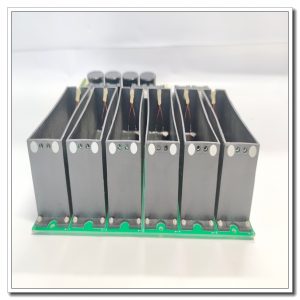
Technical description This servo system module adopts vertical cabinet‑mount installation, slide‑lock mechanical fastening structure, protection grade IP20, must be installed inside control cabinet, cannot be exposed to dust, moisture or oil mist on site. The allowable three‑phase AC input voltage is 324‑528 VAC, 50‑60 Hz, rated input current 28.6 A. After internal rectification, it outputs shared DC bus voltage 530‑680 VDC for all connected axis modules, energy conversion efficiency reaches 98%. Continuous output current is 33.8 A, peak transient current can reach 200 A for motor acceleration, peak power output up to 136 kW. Built‑in factory‑installed EMI filtering circuit suppresses grid harmonic interference and improves stability of multi‑axis synchronous running. Internal main circuit contains large‑capacity DC‑link capacitor 660μF and matching inductor 500μH; when motor generates regenerative energy during deceleration, external shunt braking resistor module (such as 1394‑SR series) must be configured for energy dissipation, the unit itself does not integrate high‑power braking resistance.
It is equipped with SCANport dedicated communication interface, compatible with Bulletin 1201 handheld operator unit. Operators can complete parameter modification, servo gain auto‑tuning, fault viewing and quick commissioning on site without upper computer software. The ±10 VDC analog command channel uses 12‑bit D/A conversion, resolution 4.88 mV, receives external speed or torque instruction signals, realizing non‑digital‑bus connection with third‑party controllers and numerical‑control systems. It can cooperate with SERCOS optical fiber bus to realize high‑speed deterministic motion data interaction with upper‑level Logix series controllers.
Rich built‑in protection and diagnosis functions cover power‑on self‑test, over‑current, over‑voltage, under‑voltage, thermal overload, bus‑link fault and encoder feedback abnormality monitoring. Front‑panel multi‑group LED indicator lamps directly display power status, system running state and fault alarm codes, convenient for on‑site troubleshooting. Real‑time fault codes and diagnostic data can be uploaded to upper‑level control system via backplane bus. There is no built‑in main fuse inside the hardware; users must configure external short‑circuit, over‑current protection devices on the AC input loop. Hot‑swap function is not supported. Before disassembly and replacement, main power supply must be cut off, and sufficient waiting time is required for internal high‑voltage capacitors to complete discharge to avoid electric‑shock risk.
Physical and environmental parameters: net weight 16.24 kg, vertical cabinet installation, top, bottom and side surfaces must reserve enough airflow clearance for heat dissipation; ambient temperature derating is required when installation altitude exceeds 1000 m. Operating temperature range 0‑50℃; storage and transportation temperature ‑40‑+85℃; relative humidity 5%‑95% non‑condensing environment. The product complies with UL and CE industrial safety certification standards.
Compatible matching accessories:
- Handheld debugging unit: 1201‑HMI
- External shunt braking resistor: 1394‑SR9A / 1394‑SR36A
- Subsequent axis modules: 1394‑AM series single‑axis servo modules
- Applicable servo motors: 1326AB, 1326AS series AC servo motors
Application Scenarios
- Legacy numerical‑control machine tools: used as multi‑axis servo power master unit for feed axes and auxiliary spindle axes, realizing high‑precision positioning and stable speed operation of mechanical structures. It is widely used for maintenance of old imported machine‑tool equipment.
- Metal forming and stamping machinery: driving feeding and positioning servo axes of press and stamping equipment, adapting to high‑peak‑torque instantaneous working conditions.
- Packaging and printing machinery: multi‑axis linkage control for winding, cutting, conveying and label‑printing stations, realizing synchronized motion of multiple process stations.
- Textile special‑purpose machinery: driving roller and material‑feeding servo shafts, adapting to frequent variable‑speed continuous operation of textile production lines.
- Automated assembly and special‑purpose non‑standard equipment: for multi‑axis positioning platforms, material‑handling mechanisms; used as spare‑part replacement for original 1394‑series motion‑control systems.
During practical deployment, firmware versions of system module and each connected axis module must be kept consistent, otherwise abnormal communication and motion disorder may occur. Sufficient heat‑dissipation gap shall be reserved around the unit inside cabinet. For frequent deceleration and large‑inertia load occasions, parameters of external shunt braking resistor must match the actual working condition. Do not input AC voltage out of 324‑528 VAC allowable range, otherwise internal power semiconductor devices will suffer permanent damage. Periodically check terminal fastening torque and dust accumulation on cooling holes during long‑term operation. Since this series is discontinued by original factory, there is no subsequent new‑model iteration, and spare‑part supply mainly depends on inventory and refurbished resources.



Reviews
There are no reviews yet.