


Description
‑ Power Supply: Powered by excitation rack back‑plane bus, 24 VDC auxiliary power
‑ Power Consumption: approx 12.1 W
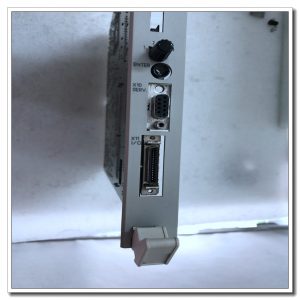
‑ Mechanical Structure: Eurocard plug‑in board for UNITROL rack, metal front panel, back‑plane bus connector, redundant inter‑board synchronization interface
‑ On‑board Resources: 32‑bit high‑performance processor unit, flash memory for firmware and parameter storage, SDRAM for real‑time data cache, redundant synchronization logic unit, internal back‑plane bus controller, module self‑diagnosis circuit, conformal‑coating protection layer
‑ Communication Interface: Internal dedicated high‑speed back‑plane bus for each functional board inside rack; inter‑board redundant synchronization channel for dual‑CPU data mirroring
‑ Galvanic Isolation: Internal logic power adopts galvanic isolation, isolation rating 2500 VAC
‑ Core Function: AVR voltage‑regulation closed‑loop calculation, excitation protection algorithm, excitation limit logic, sequence control, redundant hot‑standby data mirroring, master‑standby seamless switch, event‑recording and disturbance‑recording storage
‑ Protection: internal over‑voltage, over‑current monitoring for on‑board circuit
‑ Status LED Indicators: Power indicator, Module Fault indicator, running status LED, master/standby mode LED, system alarm LED
‑ Weight: approx 1.04 kg
‑ Acts as redundant main‑control unit of UNITROL6000 excitation rack, supports dual‑CPU hot‑standby configuration. It can work as master board to execute full AVR automatic voltage‑regulation closed‑loop algorithm for generator terminal voltage stable control; or run in standby mode for real‑time data mirror synchronization.
‑ Runs complete excitation protection and multiple‑set excitation limit logic (over‑excitation, under‑excitation, stator‑current limit etc.), performs alarm or trip action according to operating condition.
‑ Implements system sequence control, manages startup‑shutdown logic, paralleling interlock condition judgment, coordinates data exchange between sampling board, communication board, PSS board, synchronization board and I/O boards via back‑plane bus.
‑ Realizes master‑standby seamless switch: when active main‑processor breaks down, standby G3FE board takes over control without excitation system interruption, improving overall system availability.
‑ Stores excitation firmware, multi‑group generator parameter sets, fault event logs and disturbance‑recording data; supports parameter downloading and event reading via external communication boards.
‑ Module self‑diagnosis monitors processor operating status, memory health, redundant synchronization link, rack power‑supply and back‑plane bus communication; detects system hardware abnormality, uploads fault‑alarm information. Conformal‑coating improves long‑term reliability under harsh power‑plant site condition.
‑ Cannot run independently; in redundant system, two G3FE boards work in pair and cooperate with all other functional boards. HENF452697R1 is hardware revision variant of G3FE series; pin‑compatible within G3FE revision family, cannot directly interchange with other series excitation boards.
‑ Continuously monitors system running status, memory integrity, redundant synchronization link, internal bus communication and module hardware health. Detected faults activate fault LED and output system fault word.
‑ No local numerical display; operating parameters, event records and fault codes are read via excitation commissioning tool or upper‑level HMI workstation.
‑ Module hardware failure in master mode will trigger automatic switch to standby processor; if both G3FE boards fail, excitation system will lose control and generator excitation trip occurs.
‑ Back‑plane connector: connects to excitation rack internal high‑speed bus, exchanges data, commands and diagnostic status with all other plug‑in functional boards.
‑ Redundant inter‑board synchronization interface: completes real‑time data mirroring between two redundant main‑processor boards.
‑ Mounting: Plug‑in installation inside UNITROL excitation cabinet rack
‑ Operating Temperature: ‑20 °C ~ +60 °C
‑ Storage Temperature:−40 °C ~ +70 °C
‑ Relative Humidity: 5‑95 %RH, non‑condensing
‑ Protection Class: IP20 (cabinet internal)
- G3FE redundant main‑processor control board (HENF452697R1)
Complementary parts: UNITROL excitation rack and back‑plane, matching second G3FE board for redundancy, each auxiliary functional board, excitation commissioning software, matching firmware and generator parameter files.
‑ Power off the whole excitation rack before inserting or removing this main‑control board. For redundant configuration, two G3FE boards must use strictly matching firmware version; mismatched firmware will lead to synchronization failure or master‑standby switch anomaly.
‑ For spare‑part replacement: Verify complete part number HENF452697R1. After replacement, confirm back‑plane bus identification, download corresponding firmware and generator parameter set, verify system startup, redundant synchronization, master‑standby switch test, AVR regulation, protection logic and fault‑reporting function. Hardware revision mismatch will lead to redundancy function incompatibility risk.
‑ Module hardware fault will affect excitation system redundant availability.
Thermal‑power and hydro‑power generator excitation cabinets requiring high‑reliability redundant control; ABB UNITROL6000 generator excitation system; industrial spare‑part replacement for excitation redundant core main‑processor computing unit.
- UNITROL6000 excitation system dedicated G3FE redundant main‑processor board, undertakes AVR voltage‑regulation, excitation‑protection, limit‑logic, sequence‑control and hot‑standby redundant master‑standby switch function, hardware variant HENF452697R1.
- Conformal‑coating processing, adapts to power‑plant high‑humidity and corrosive harsh site environment.
- Supports dual‑CPU hot‑standby seamless switch, improves excitation system running reliability for important generating units.
- High‑reliability processor and memory design, supports event‑recording and disturbance‑recording for post‑fault analysis.
- Comprehensive system‑level self‑diagnosis function including redundant link monitoring, convenient for on‑site system‑fault location.
- Standard Eurocard rack‑mount plug‑in structure, convenient installation and on‑site maintenance.
Reviews
There are no reviews yet.