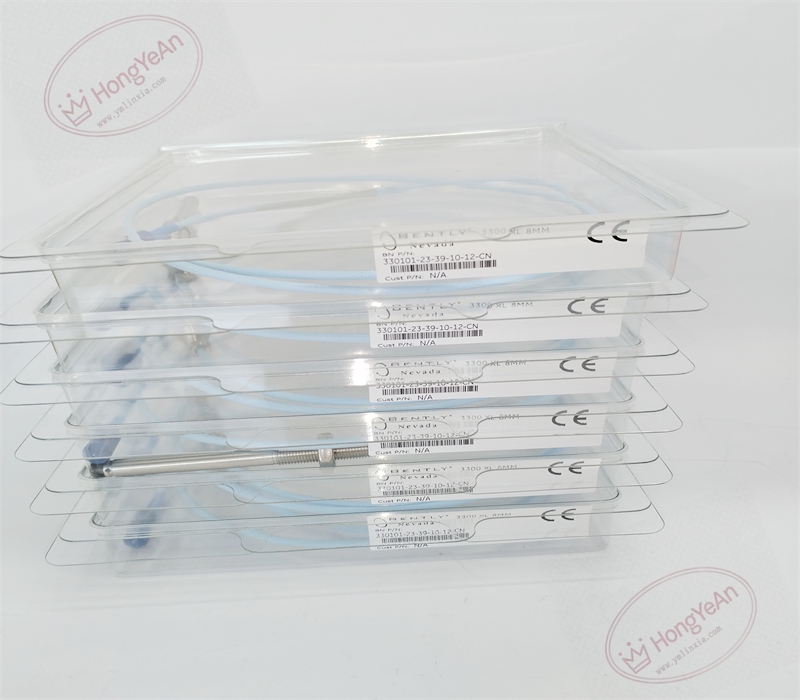
Description
Hardware Specifications
- Part Type: 8 mm eddy‑current proximity probe, integral FluidLoc oil‑resistant tri‑axial coaxial cable, ClickLoc miniature gold‑plated coaxial connector, non‑armored construction
- Mounting: 3/8‑24 UNF‑2A male thread; unthreaded probe length 2.3 inch; wrench‑flat for torque‑controlled installation into machine housing or mounting bracket
- Termination: Integral 1‑meter 75‑ohm FluidLoc tri‑axial coaxial cable, terminated with ClickLoc male connector for connection to extension cable and proximitor sensor
- Mechanical Construction: Probe tip PPS polymer; probe body AISI‑304 stainless‑steel; Viton O‑ring for sealing; passive coil‑insulator assembly with no on‑board PCB. FluidLoc cable jacket resists degradation from continuous exposure to turbine lube‑oil mist.
- Environmental Ratings: Probe operating temperature −35 °C ~ +177 °C; storage −40 °C ~ +185 °C; relative humidity 5‑95 % non‑condensing; vibration performance complies with API‑670 rotating‑machinery transducer standardBaker Hugh…
- Electrical Characteristics: Nominal sensitivity 7.87 V/mm (200 mV/mil); linear measurement range 0.25 mm‑2.25 mm; frequency response DC‑10 kHz (−3 dB); minimum target flat‑surface diameter 15.2 mm; recommended minimum shaft diameter 50.8 mm. Must match total system length setting of paired 3300‑XL proximitor sensor. CN suffix is regional marking without modification to core electrical performance.
- Signal Compatibility: Outputs gap‑proportional raw eddy‑current signal to 3300‑XL proximitor sensor; proximitor converts gap signal for acquisition by monitor modules.
Core Functions
- Delivers non‑contact clearance measurement between probe tip and rotating metallic shaft surface. Converts physical shaft‑to‑probe gap into analog voltage signal for radial vibration, shaft run‑out and thrust‑position monitoring. FluidLoc cable construction provides enhanced chemical resistance in locations saturated with turbine lubricating‑oil mist, where standard coaxial cable jackets would degrade prematurely.
- Deployed on steam‑turbines, gas‑turbines, centrifugal compressors and other critical rotating‑machinery for dynamic vibration amplitude and static thrust‑position acquisition, supporting machinery protection and condition‑diagnosis.
- Requires complete matched transducer chain: probe + extension cable + 3300‑XL proximitor sensor. Total system length must strictly conform to proximitor calibration setting. Mismatched cable length will degrade sensitivity and linear‑range performance.
- Commissioning static gap shall be set near mid‑linear‑range (approx. 1.27 mm / 50 mil, corresponding to −10 Vdc gap voltage). Maintain physical separation between adjacent probe tips to avoid cross‑talk interference.
- Widely used in power‑generation, petrochemical and oil‑gas industrial sites. Distinguished by ordering suffix codes:‑23‑39‑10‑12‑CN defines 2.3‑inch unthreaded length, FluidLoc oil‑resistant cable, 1 m integral non‑armored cable, CN regional variant. Replacement of probe, cable or proximitor demands full gap calibration and linearity verification.
Installation Requirements
- Mounting requirement: Screw probe into threaded mounting bracket or machine housing. Apply specified torque for 3/8‑24 UNF thread; avoid over‑torque to prevent thread deformation and internal coil damage. Reserve sufficient clearance between probe tip and rotating shaft to eliminate rub risk during machine transient operating conditions. Avoid applying bending stress to the 2.3‑inch unthreaded body during installation.
- Cable handling rule: Minimum cable bend radius 25.4 mm; prohibit sharp bends, pinching, crushing or tensile pulling on FluidLoc tri‑axial coaxial cable. Tighten ClickLoc connector finger‑tight plus maximum 1/8‑turn; over‑torque will damage gold‑plated contact pins.
- Field‑wiring specification enforcement: Route probe coaxial cable separately from high‑voltage power and large‑current motor cables to suppress electromagnetic interference. Implement single‑point shield‑grounding at proximitor‑sensor end to prevent ground‑loop noise. Verify total system length (probe integral cable plus extension cable) matches proximitor configuration setting.
- Environmental control: Although FluidLoc cable tolerates heavy oil‑mist exposure, avoid direct continuous liquid‑oil jet impingement and hot‑spots exceeding rated temperature range. Outer‑jacket mechanical abrasion will result in signal drift or intermittent measurement faults.
- Pre‑installation visual inspection: Inspect probe tip for chipping or cracking, probe body for bending deformation, cable jacket for cuts/swelling, connector pins for bending or contamination before commissioning. After mechanical mounting, measure static gap voltage to confirm probe operates within valid linear working range.
- Part‑number cross‑version distinction: 330101‑23‑39‑10‑12‑CN uses FluidLoc oil‑resistant cable. Standard‑cable variants cannot directly substitute in high‑oil‑mist environments. Variants with different unthreaded length, cable length, armor option and regional suffix cannot directly substitute; replacement requires re‑verification of total system length and gap‑voltage calibration.
Common Failure Modes
‑ FluidLoc cable‑jacket mechanical abrasion, internal coaxial conductor micro‑fracture: intermittent gap‑voltage drift, noisy vibration readings, sporadic signal drop‑out. ‑ Probe‑tip mechanical impact or crack: degraded linear performance, permanent measurement offset. ‑ ClickLoc connector pin contamination or over‑torque damage: unstable signal connection, high‑frequency noise superimposed on vibration waveform. ‑ Long‑term over‑temperature exposure: internal coil insulation degradation, permanent sensitivity shift. ‑ Shaft‑to‑probe rub due to insufficient installation clearance: physical destruction of probe tip and coil assembly, complete loss of measurement signal.
-300x300.jpg)
Reviews
There are no reviews yet.