.jpg "黑马-F35-982200416-(1)")
.jpg "黑马-F35-982200416-(2)")
Description
.jpg)
Key technical attributes
- Processing core: Safety‑oriented dual‑voting processor architecture, meets SIL3 functional‑safety requirements.
- Program memory and data memory are specially designed for safety application, supports program cycle execution and comprehensive self‑diagnosis.
- Multiple built‑in communication interfaces for safety bus connection with I/O racks and communication partners. Supports redundant running mode for improving system reliability.
- Powered by HIMax rack backplane. Supports hot‑swap under redundant configuration.
- Rich diagnostic functions: Detects internal hardware anomalies, program execution errors and bus communication failures. Event logs and fault codes can be uploaded to monitoring workstation.
- Operating environment: Operating temperature 0℃ ~ +60℃; storage temperature‑40℃ ~ +85℃; relative humidity 5‑95% non‑condensing; cabinet‑mount installation.
- Compatibility notes: Works within HIMax rack framework, cannot be used for HIMatrix hardware. After replacement, download validated safety project program, verify bus communication status and all I/O point responses.
Mechanical characteristics
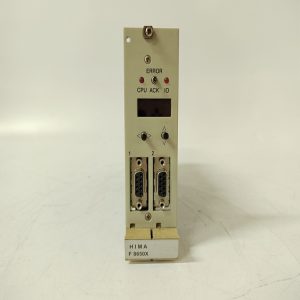
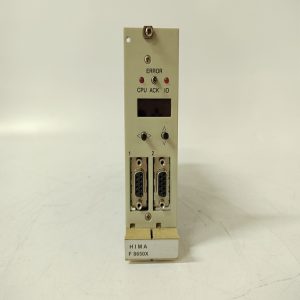
Standard single‑slot plug‑in CPU module. Front panel LED indicators display run status, system fault and bus communication activity. Internal circuit board adopts conformal‑coated treatment, suitable for industrial cabinets with dust and slight corrosive gas. Signal interaction with I/O boards is completed through rack backplane gold‑plated connectors.
On‑site application scenarios
Placed in SIS safety cabinets of chemical plants and power‑generation sites. As the main computing core of safety interlock system, it receives field sensor signals from each I/O module, executes safety‑logic calculation, and outputs interlock trip commands when dangerous working conditions are detected. When adopting dual CPU redundancy, one‑channel failure triggers alarm and the backup CPU continues safety‑logic operation. For single‑CPU configuration, module failure will result in the whole safety‑interlock system out‑of‑service.
Installation and commissioning points
- Strict ESD anti‑static protection during handling. Hot‑swap is available only under redundant system setup.
- Keep safety bus communication cables separated from high‑power cables to avoid electromagnetic interference.
- After physical installation, download complete verified safety project, check system event log, confirm no hardware mismatch alarms.
- Retain full backup of safety application program. On‑site component‑level repair is forbidden; replace whole CPU assembly for permanent hardware damage.
Typical field‑encountered faults
- System cannot go online: Check backplane power supply, confirm downloaded project matches hardware revision.
- Bus communication interruption: Inspect bus cable connection status, connector oxidation and module seating condition.
- Intermittent system fault alarm: Focus on cabinet heat dissipation, dust accumulation and backplane contact quality.
- CPU fails to start: Re‑download project program, check hardware compatibility.
-300x300.jpg)
Reviews
There are no reviews yet.